.jpg)
.jpg)














Renowned Indian Lawyer And Scholar Rishabh Gandhi Explores Ethical and Legal Dimensions of Samadhimaran at Prestigious International Conference.
New Delhi [India], May 27: The Fourteenth International Conference on Religion & Spirituality in Society, held at the esteemed Institute of Religious Studies, Universidad Complutense Madrid, welcomed scholars, researchers, and practitioners from around the globe to explore the intricate relationship between religion and society. Among the distinguished speakers was Rishabh Gandhi, a prominent legal scholar, [...]


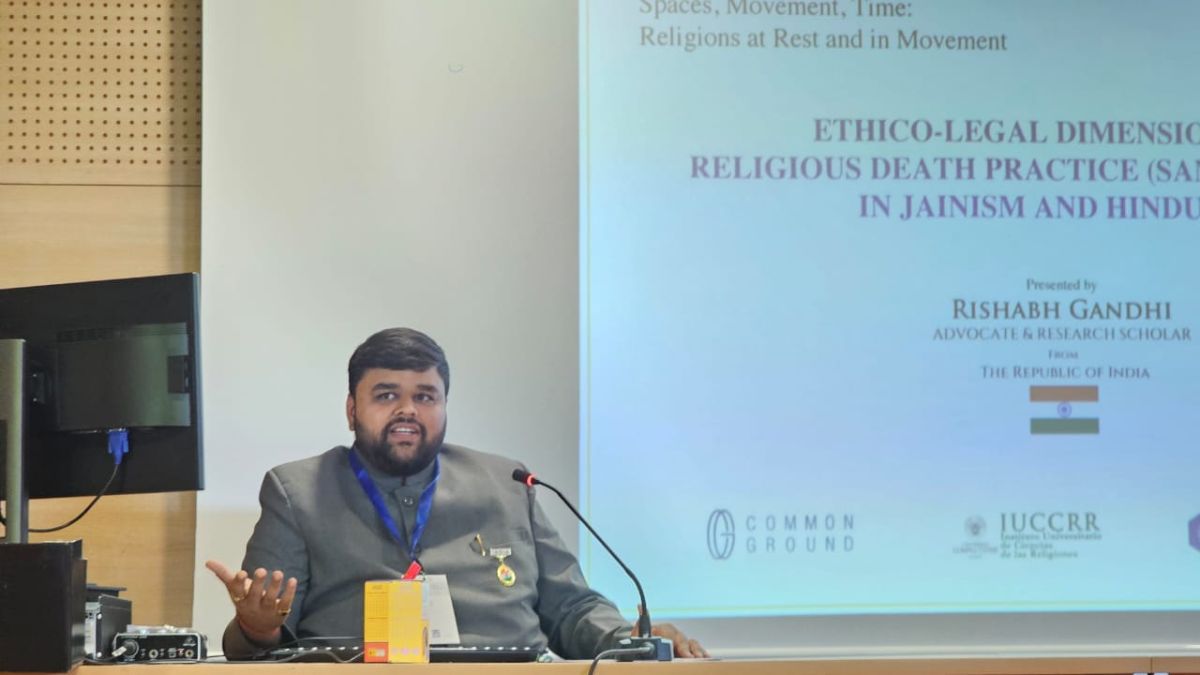

New Delhi [India], May 27: The Fourteenth International Conference on Religion & Spirituality in Society, held at the esteemed Institute of Religious Studies, Universidad Complutense Madrid, welcomed scholars, researchers, and practitioners from around the globe to explore the intricate relationship between religion and society. Among the distinguished speakers was Rishabh Gandhi, a prominent legal scholar, who delivered a compelling oral presentation, titled “Ethical Legal Dimensions Of Religious Death Practice Of Samadhimaran In Jainism And Hinduism.”
The conference, established in 2011, is part of the Religion in Society Research Network, which delves into the evolving nature of spirituality and its impact on society. This year’s event, taking place from May 23 to May 24, 2024, provided a platform for thought-provoking discussions and groundbreaking research.
Gandhi’s presentation focused on the ancient practices of Samadhimaran in Jainism and Prayopavesa in Hinduism, both of which involve voluntary, peaceful fasting unto death. His exploration of these practices touched on ethical, legal, and bioethical considerations, sparking deep interest and debate among attendees.
Jainism and Hinduism: Ancient Practices of Fasting Unto Death
Hinduism, the world’s third-largest religion, is centered on the belief in Karma and the pursuit of Moksha—liberation from the cycle of birth, death, and rebirth. Devotees seek ultimate spiritual freedom and unity with the divine through various paths, including devotion, knowledge, and disciplined practices. Jainism, an ancient Indian religion, emphasizes extreme ahimsa (non-violence), anekantavada (non-absolutism), and aparigraha (asceticism) as the paths to Moksha.
A central focus of Gandhi’s presentation was the Jain practice of Sallekhana-Santhara-Samadhimaran, an ancient tradition of deep meditation and fasting unto death. Originating from Jain Aagamas, this practice involves a voluntary, gradual reduction of food and liquid intake, undertaken with a peaceful, detached mindset. Typically observed by elderly or terminally ill individuals, the aim of Sallekhana is to achieve death with equanimity. Remarkably, it is estimated that one person in India undertakes this practice every day.

Legal and Ethical Controversies
Gandhi highlighted the legal controversies surrounding these practices. In India, the Rajasthan High Court banned the practice of Sallekhana in 2015, deeming it punishable by imprisonment as an attempt to suicide. This decision prompted significant protests from the Jain community, leading to an appeal in the Supreme Court of India. The Supreme Court granted an interim stay on the High Court’s judgment, with the final decision still pending.
The Hindu practice of Prayopavesa, while less common today, also involves voluntary, gradual abstention from food and drink, performed with a peaceful, spiritual mindset. This practice is undertaken by individuals who feel their life purpose is complete and seek Moksha. Gandhi shared poignant case studies, including that of Acharya Vidyasagar, who attained Samadhi Maran in February 2024 at the age of 77 after a decade-long gradual reduction of food intake.
Case Studies: Personal Journeys of Samadhimaran and Prayopavesa
One notable case discussed was that of Robert Hansen, a California native who converted to Hinduism and adopted the name Shivay Subramaniyaswamy. Diagnosed with advanced, metastasized intestinal cancer in 2001, Hansen undertook Prayopavesa, ultimately achieving Samadhimaran after 32 days of fasting. Such stories underscore the profound spiritual commitment and ethical considerations involved in these practices.
Right to Die: Balancing Rights and Regulations
Gandhi’s presentation also examined the broader implications of the right to die as a component of the right to life, privacy, religion, and bioethical prerogatives. He emphasized the need for balanced regulations that respect religious freedoms while safeguarding individual rights and public health.
The presentation concluded with a call for further dialogue and research into the ethical and legal dimensions of religious death practices. Gandhi stressed the importance of understanding these practices within their cultural and spiritual contexts while addressing contemporary legal and ethical challenges.
Conference Highlights and Future Directions
The Fourteenth International Conference on Religion & Spirituality in Society provided a dynamic forum for exploring the multifaceted relationships between religion, spirituality, and society. Attendees praised Gandhi’s presentation for its depth, rigor, and sensitivity in addressing complex issues.
Looking ahead, the Religion in Society Research Network aims to continue fostering scholarly dialogue and collaboration on pressing issues at the intersection of religion and society. The insights gained from this conference will contribute to ongoing efforts to navigate the ethical and legal landscapes of religious practices worldwide.
In summary, Rishabh Gandhi’s exploration of the ethical and legal dimensions of Samadhimaran and Prayopavesa provided a significant contribution to the conference, highlighting the need for nuanced understanding and thoughtful regulation of these profound spiritual practices.
One can connect with him on: https://www.linkedin.com/in/rishabhgandhi/?originalSubdomain=in
And Visit their website – https://www.rgaa.co.in/
If you have any objection to this press release content, kindly contact pr.error.rectification@gmail.com to notify us. We will respond and rectify the situation in the next 24 hours.